

AI Renovation Cost Estimator (2026)
Remodelum uses AI trained on real project data to generate detailed estimates that reflect your ZIP code's labor market, your scope of work, and your finish level.
Describe your project, upload photos and get a tailored cost estimate for your renovation. Broken down by categories. Download in PDF.
Get started - Requires creating a workspace with Remodelum
Get your renovation estimate
Tell us about your project and we'll build a ZIP-code accurate, category-by-category cost estimate. Takes under a minute.
Estimate No. RA-20260823-11213
Kitchen renovation estimate
A complete budget for a 250 sq ft kitchen renovation in ZIP code 11213, with mid-range finishes. The categories and amounts below come from the provided project data.
A detailed planning budget organized by professional services and project purchases.
- ZIP code
- 11213
- Country
- USA
- Renovation
- Kitchen
- Finish quality
- Mid-range
- Area
- 250 sq ft
Detailed cost breakdown
The full budget is organized into professional services and purchases. Expand or collapse either section to review every category and its scope.
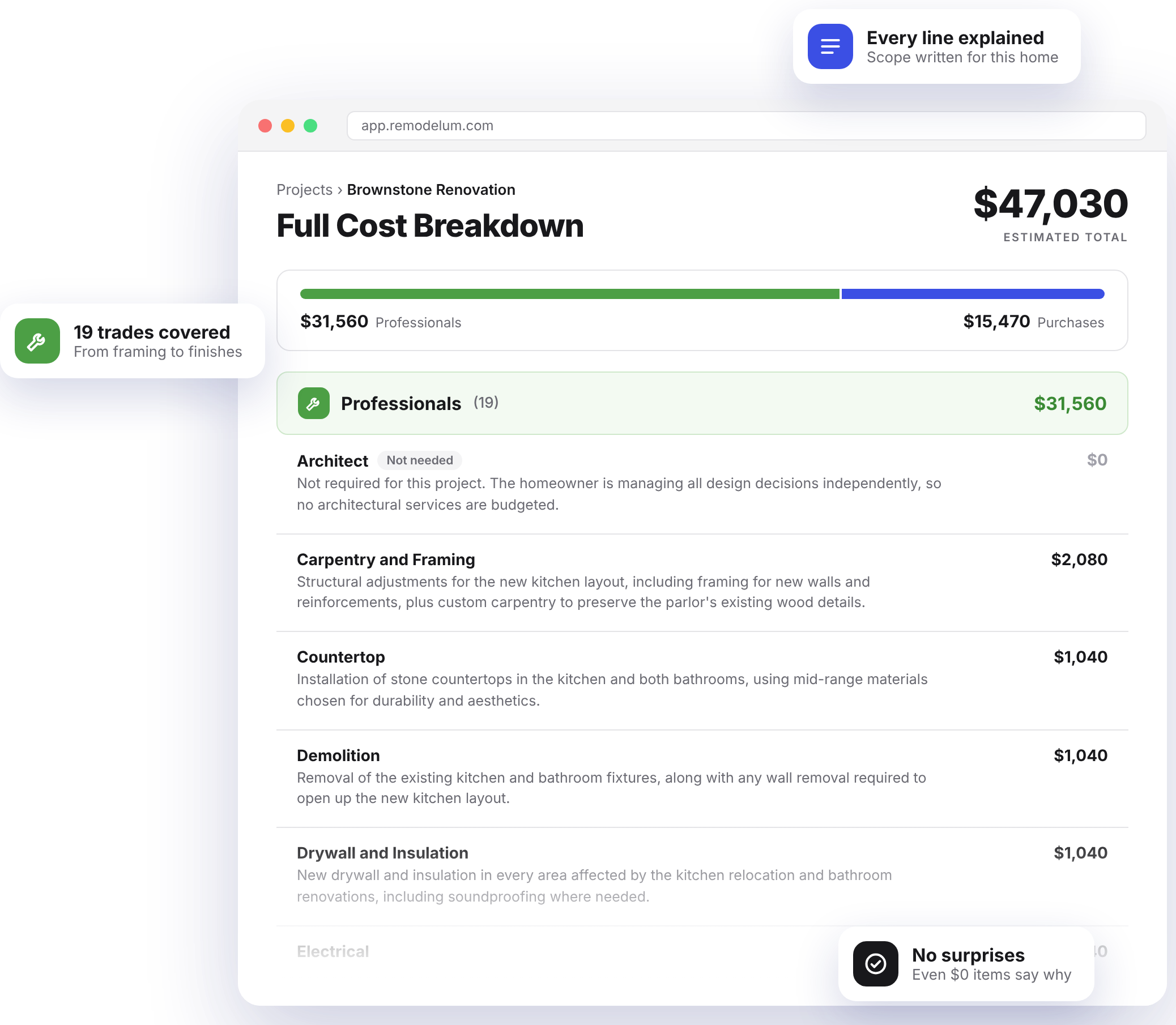
Professionals · 13 categories$19,340
Labor, design, construction, installation, and project-management services.
| Category | Scope | Cost |
|---|---|---|
| Fees, profit and overhead | General contractor fees covering project management, coordination of trades, and overhead costs associated with the kitchen renovation. | $5,180 |
| Countertop | Fabrication and installation of mid-range countertops, such as quartz or granite, for the kitchen. | $2,640 |
| Electrical | Updating electrical wiring to support new appliances and lighting, including installation of additional outlets and under-cabinet lighting. | $2,415 |
| Plumbing | Reconfiguration of plumbing to accommodate new sink and dishwasher locations, including necessary pipework adjustments and connections. | $1,935 |
| Flooring | Installation of mid-range flooring materials, such as laminate or tile, suitable for a kitchen environment. | $1,560 |
| Demolition | Demolition of existing kitchen cabinetry, countertops, and possibly flooring to prepare for new installations. | $1,240 |
| Tile installation | Labor for installing backsplash tiles and any floor tiles, ensuring proper alignment and finish. | $985 |
| Designer | Interior design services to select finishes, colors, and layout optimization for the kitchen. | $860 |
| Carpentry and framing | Minor carpentry work to adjust framing for new cabinetry and possibly create custom storage solutions. | $690 |
| Painting | Painting of kitchen walls, ceiling, and trim with mid-range quality paint. | $645 |
| Finish and trim | Installation of trim and finishing touches to complete the kitchen renovation, including baseboards and crown molding if applicable. | $615 |
| Architect | Minimal architectural services for layout optimization and ensuring compliance with building codes. | $575 |
| Mechanical | No significant mechanical work is anticipated beyond standard plumbing updates. | $0 |
Purchases · 12 categories$16,030
Materials, fixtures, equipment, furnishings, permits, and other project purchases.
| Category | Scope | Cost |
|---|---|---|
| Cabinetry and built-ins | Installation of new mid-range kitchen cabinets, including both upper and lower units, with standard hardware, designed to maximize storage and functionality within the 250 sqft space. | $6,150 |
| Appliances | Purchase and installation of mid-range kitchen appliances including a refrigerator, stove, dishwasher, and microwave, offering good functionality and durability without premium features. | $3,280 |
| Building materials | Purchase of materials including paint, drywall, and flooring materials suitable for a mid-range kitchen renovation. | $1,540 |
| Tiles and stones | Supply of mid-range tiles for kitchen backsplash and possibly flooring, depending on design choices. | $1,085 |
| Doors and windows | Replacement or refurbishment of kitchen windows to improve energy efficiency and aesthetics. | $960 |
| Lighting | Purchase and installation of mid-range lighting fixtures, including ceiling lights and under-cabinet lighting. | $785 |
| Plumbing fixtures | Purchase of a mid-range kitchen sink and faucet, matching the overall renovation quality. | $640 |
| Furnishing | Purchase of bar stools or a small dining set if space allows, to complement the kitchen design. | $520 |
| Miscellaneous | Contingency for unforeseen expenses or minor additional materials needed during the renovation process. | $495 |
| Permits | Obtaining necessary permits for kitchen renovation, including electrical and plumbing work. | $310 |
| Hardware and fasteners | Purchase of mid-range cabinet hardware and necessary fasteners for installation. | $265 |
| HVAC equipment | No significant HVAC equipment changes are anticipated for this kitchen renovation. | $0 |
Analysis and assumptions
This provided budget includes professional services and purchases for the stated location, area, renovation type, and mid-range finish quality. Actual costs can vary with site conditions, selections, taxes, and changes to scope.
- Plan scope
- Compare proposals
- Track purchases
- Record payments
KEY FEATURES OF THE AI ESTIMATORKey Features of Remodelum’s AI Renovation Cost Estimator
-
Labor and material costs adjusted to the specific zip-code of the renovation
-
Estimate kitchen, bathroom, whole-home renovations and more
-
Includes breakdown for main cost categories of your renovation
-
Customize materials, finishes, location and other cost categories
-
Use the estimated cost of your renovation as a first step to plan and track your entire project
What Makes an AI Renovation Estimator Different
AI RENOVATION ESTIMATORNational survey averages — they collect data from thousands of homeowners who've completed renovations and average the results. The problem is that a kitchen remodel in Nashville and a kitchen remodel in San Francisco have almost nothing in common. Averages produce ranges so wide — "$15,000 to $130,000" — that they're not useful for planning an actual budget.
Per-square-foot formulas — they multiply your room size by a regional cost per square foot. This is faster but still ignores the variables that actually drive renovation costs: finish quality, structural complexity, number of plumbing fixtures being moved, age of the property, and local permit requirements.
AI renovation cost estimators solve this by doing what a knowledgeable contractor does intuitively — they combine multiple variables simultaneously and adjust for local market conditions. The result is a planning-level estimate that's specific to your project rather than the average of everyone else's.
How Remodelum's AI Generates Your Estimate
METHODOLOGYRemodelum's estimates are generated from a proprietary database of real renovation projects — not survey responses, not published averages, not formulas applied to square footage alone.
The model combines:
ZIP code–level labor market data Labor costs vary more than most homeowners expect. A licensed electrician in New York City bills 2–3x what the same work costs in Memphis. Remodelum adjusts every estimate for the labor market in your specific ZIP code — not your state, not your metro area, your ZIP code.
Scope-specific cost modeling The estimate changes based on what you're actually doing. Moving plumbing costs more than leaving it in place. Custom cabinetry costs more than stock. A second-story addition requires structural engineering that a ground-floor addition doesn't. Remodelum's model reflects these differences rather than averaging them away.
Material cost data updated for 2026 Material costs have fluctuated significantly over the past three years. Lumber, copper, and appliance prices in 2026 are different from what they were in 2023. Remodelum's database reflects current material pricing rather than historical averages that no longer reflect what contractors are actually paying.
Category-level breakdown Every Remodelum estimate is broken down by category — demolition, structural, mechanical, finishes, permits — so you can see where the money goes and why. If a contractor's bid comes in higher than expected in one category, you'll know whether that's reasonable or a red flag.
HOW TO ESTIMATE GUIDEHow to Estimate Renovation Costs Using Remodelum with 2 Easy Steps
Enter your ZIP code, renovation type, finish quality, and square footage
Describe your renovation and upload photos for a more accurate estimate
AI vs. GENERIC ESTIMATOR COMPARISON AI Renovation Estimator vs Generic Calculator — The Difference in Practice
Here's a concrete example of why it matters: A homeowner in Austin, Texas is planning a full kitchen renovation — new cabinets, countertops, appliances, tile backsplash, updated lighting, and relocating the sink.
Generic Calculator
$25,000 – $75,000
National average. No breakdown. No local adjustment.
Remodelum AI Estimate — Austin, TX
| Demolition and prep | $2,200 – $3,100 |
| Cabinetry (semi-custom) | $12,000 – $18,000 |
| Countertops (quartz) | $4,500 – $6,500 |
| Appliances (mid-range) | $6,000 – $9,000 |
| Plumbing relocation | $2,800 – $4,200 |
| Electrical and lighting | $1,800 – $2,600 |
| Tile and backsplash | $1,200 – $1,800 |
| Permits (Austin, TX) | $850 – $1,200 |
| Total estimate | $31,350 – $46,400 |
The homeowner now knows which categories drive the cost, what the Austin labor market adds to the national average, and what a reasonable contractor quote looks like for each line item. When three contractor bids come in at $38,000, $44,000, and $67,000, they can identify immediately that the third bid has an unexplained premium — and ask why.
That is what a useful AI renovation estimate looks like. Not a range. A plan.
HOW TO ADJUST AN ESTIMATE GUIDEHow to Adjust a Renovation Estimate Using Remodelum with 2 easy steps:
Describe the adjustments you are thinking about - Upload pictures if needed
Check the before and after estimate breakdown - Accept or discard adjustments
TYPES OF RENOVATIONS COVEREDWhat Remodelum's AI Estimator Covers
Whole House
Whole House Renovation Cost Estimator
Room-by-room estimate for complete home renovations, by ZIP code.
Kitchen
Kitchen Remodel Cost Estimator
Cabinets, countertops, appliances, and labor costs by ZIP code.
Bathroom
Bathroom Remodel Cost Estimator
Half bath, full bath, and master bath cost breakdowns.
Home Addition
Home Addition Cost Estimator
Room additions, second stories, and garage conversions.
Patio
Patio Renovation Cost Estimator
Pavers, concrete, pergolas, and outdoor living spaces.
Basement
Basement Finishing Cost Estimator
Finishing, refinishing, and basement conversion costs.
KEY DIFFERENTIATING FACTORS
Beyond the Estimate — What Separates Remodelum from Other AI Tools
Most AI renovation estimators give you a number and stop there.
Remodelum is built differently because the estimate is the beginning, not the end.
After your AI estimate, Remodelum lets you:
Iterate the scope — adjust materials, room size, finish level, and structural complexity to see how each decision moves the total cost in real time. Most homeowners go through 3–5 scope iterations before finalizing a budget. Remodelum makes each iteration immediate rather than requiring a new estimate request.
Compare contractor quotes — use your AI estimate as a baseline to evaluate contractor bids. When a contractor quotes $15,000 for plumbing work your estimate shows should cost $4,000–$6,000, you know to ask for an itemized breakdown before accepting.
Track actual costs — once renovation begins, log contractor invoices and payments against your estimate in the same place. The AI estimate becomes your financial baseline for managing the renovation — not a document you generated once and forgot about.
Store documents — contracts, permits, receipts, and warranties all stored in the same project. Everything in one place, from the first estimate to the final payment.
No other homeowner-facing AI renovation tool covers all four stages of the renovation journey.
REMODELUM’S ACCURACY
Is AI Renovation Cost Estimation Accurate Enough to Trust?
AI renovation cost estimators leverage vast datasets of past renovation projects, material costs, labor rates, and regional economic factors to provide instant projections. But the honest answer is that no AI estimate — including Remodelum's — replaces a contractor bid for final pricing.
What AI estimates are accurate for:
Planning and budgeting — determining whether your renovation is financially feasible before investing time in contractor meetings. An AI estimate that shows a kitchen remodel will cost $40,000–$60,000 tells you whether that project fits your budget. A national average of "$15,000–$130,000" doesn't.
Evaluating contractor quotes — understanding whether a bid is reasonable, high, or suspiciously low. An itemized AI estimate gives you line-item context for evaluating bids that most homeowners don't have.
Scope decision-making — understanding how specific choices affect the total cost. Should you use custom cabinetry or semi-custom? Should you relocate the plumbing or work around it? AI estimates let you model these decisions before committing.
What AI estimates are not accurate for:
Hidden conditions — asbestos, outdated wiring, rotted subfloor, or structural issues that only become visible once walls come down. These can add 10–30% to any renovation budget and no AI can predict them before work begins.
Always build a 10–15% contingency into your AI estimate for unknown conditions. Remodelum includes a contingency line item in every estimate for exactly this reason.
Why use a home remodeling cost estimator?
-
Understand the expected cost of your renovation
-
Add or remove activities into your scope of work depending on your budget
-
Assess if there is room for negotiation in your contractor’s quotes
-
The home renovation calculator is the first step in the overall planning phase - Compare quotes and fins contractors
FAQs
-
The calculator estimates your remodeling costs based on the type of project (kitchen, bathroom, addition, etc.), your location, project size, material quality, and other custom inputs. It gives you a personalized ballpark figure instantly.
-
Yes, our Renovation Cost Calculator is completely free. You can use it as many times as you'd like to plan different projects or compare renovation options.
-
You can estimate costs for full home remodels, kitchens, bathrooms, room additions, basements, and more. The calculator adjusts based on the project type and scope.
-
Our calculator is built using real-world data, national averages, and contractor benchmarks. While it gives a reliable estimate, we always recommend getting a few actual contractor quotes to confirm your final costs.
-
No personal info is required. Just select your project details, location, and preferences, and we’ll give you an instant estimate—no sign-up needed.
-
Yes! After generating an estimate, you can download a PDF or email it to yourself or your contractor. Registered users can also save estimates to their Remodelum dashboard for future reference.
-
Yes, estimates include both labor and material costs. You can choose different material quality levels to see how your budget may change.
-
Absolutely. You can contact us or connect with a contractor through Remodelum to review your estimate and get a more detailed project proposal.